
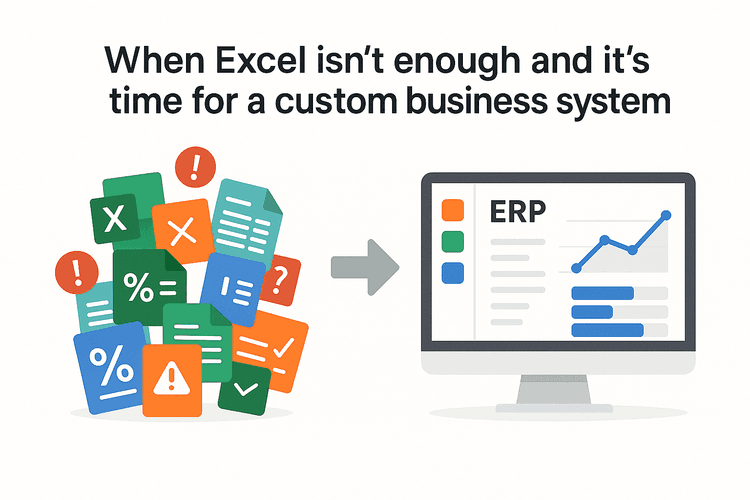
ERP system development - Excel is no longer enough ?!

By Felikss Kepss, Digital marketing specialist
ERP system development: when Excel is no longer enough and it's time for a custom business system
If your company's main "ERP system" is currently a folder with files Excel format, you are not alone
Every day, people search Google “how to use excel”, “pdf to excel”, “excel to pdf”, “excel online”, “cvs to excel”, "Excel formulas" because they try to use spreadsheets to solve problems that actually require a custom business system.
Excel is OK as a starting point. The problem starts when:
- the number of files is measured in tens and hundreds;
- each employee has “their own Excel” with their own structure;
- data no longer matches, and mistakes cost real money.
At this point, the question arises: what is systems development, what is IT systems development for companies and when needed ERP system development , not another “enhanced” Excel file?
What is ERP system development - simple and humane
Classically, ERP is an “Enterprise Resource Planning” system, a unified platform where orders, warehouse, production, finance, projects, etc. live.
ERP system development in practice means:
- development of customized systems , not “one size fits all” tools;
- custom business system development is based directly on your processes;
- software and systems development (backend + web interface);
- development of information systems and integration with existing programs .
The goal is quite simple: to manage in one place what is currently scattered among Excel, emails and various systems.
When Excel is still useful, and when ERP system development is needed
Excel is perfectly sufficient if:
- you are a small company where data is still transparent;
- it is not critical if something is lost or entered incorrectly;
- you don't need automatic integration with other systems.
There's no need to jump into a big project, because you have to grow up to it first.
But if you recognize any of this, it's probably time to think about... ERP system development or at least serious IT systems development :
- Instead of one day , the project is stalled for a week because you have to wait for someone to merge data from different Excel files;
- No one really knows which file is the latest;
- Reports to management are made manually, for example, the same work every month;
- The same information is entered in multiple places, and errors are inevitable;
- The data is simultaneously located in "some module" of the ERP, Excel, CRM and e-store, and this data does not match.
These are normal symptoms that need development of systems for internal company processes and developing data management systems, not just another Excel “upgrade”.
What distinguishes ERP system development from a simple IT system?
IT system development for companies in Latvia often means one specific tool: for example, a task system, a booking platform, an internal portal.
In turn ERP system development is:
- wider coverage - support for financial, logistics, warehouse, production, project and other functions;
- deeper development of information systems - data structure, reports, dashboards;
- integration solutions between different systems - ERP + CRM + e-shop + warehouse;
- system development with ERP integrations - in cases where a new web system is connected to an existing ERP.
In practice, it often looks like this:
- basic ERP (finished product);
- customized web systems, customer portals and internal tools;
- Developing API integrations for businesses with existing infrastructure.
Three Real Paths: How Companies Evolve from Excel to ERP
1. From Excel to a single focus system.
- development of data entry systems for companies (orders, applications, production tasks);
- development of data collection and reporting systems so that management finally sees a single picture;
- development of control panels and dashboards, these are sales, production, warehouse KPIs.
There is no full ERP here yet, but there is already development of business process management systems with real added value.
2. ERP ready + custom web systems and integrations.
- web system development for business clients (e.g. partner or customer portals);
- web systems for data entry and reporting that talk to ERP;
- development of business systems with API integrations;
- system integration and data synchronization between ERP, CRM, e-shop, warehouse.
The role of Excel is gradually being reduced to “someday we export data for analysis”.
3. Fully customized business system. This path is suitable when existing ERP solutions are too rigid and a customized system is needed:
- is being done development of customized IT systems,
- is being created custom system development for companies for a specific business model,
- at first only one module (for example, production or logistics), but over time the system grows.
Here both are performed business analysis and systems development, as well as full-cycle system development (analysis, development, maintenance).
How does the IT systems development process work in the context of ERP ?
Many are interested, how the IT systems development process works , how complex it is and how much system development costs a company.
1. Business analysis and requirements definition. Visually with your company:
- we discuss existing processes and why they are now performed using Excel;
- we define how to digitalize the company's internal processes;
- we do requirements analysis and IT system development planning.
Then it becomes clear whether you need:
- development of information systems ,
- wider ERP system development ,
- or “only” focus web systems development .
2. Solution architecture and prototype. At this stage:
- define system modules and data model;
- we define integrations (for example, how to integrate a new system with an existing ERP or CRM);
- we assess where needed Laravel system development, where React/Node, where API + existing ERP.
The result is a clear idea of what exactly we are building.
3. Development, testing and pilot project. Happens by itself systems development from idea to finished product:
- we develop modules, integrations, data entry automation systems;
- we perform testing to reduce errors;
- we launch a pilot project in a real environment with a small group of users.
At this stage, close cooperation and communication, as well as quality feedback, are especially important to ensure that the project is excellent and without any shortcomings.
4. Implementation, training and maintenance. After launch:
- we train the team by showing practically, how to improve data entry with a customized system;
- we follow up on the first weeks, correcting the nuances;
- we provide long-term IT consulting in system development and maintenance.
This is what we call full-cycle systems development, not just “program and disappear”.
How vizual.lv thinks about real value, not just technology
At Vizual, we are not interested in selling “pretty technology.” We are interested in:
- business process automation with customized systems;
- digitalization of business processes with web solutions;
- process automation solutions for businesses that really save time and reduce errors.
Technologically, it can be:
- web application development with React and Node.js;
- Laravel systems development as a solid foundation for ERP-related web solutions;
- development of systems with modern web technologies that easily integrate with ERP, CRM and other tools.
But technology is just a tool. The value is streamlined processes, less Excel chaos, and a clear picture of what's happening in the business.
What to prepare before talking to a systems development partner
To make the first conversation as productive as possible, I recommend preparing:
- Top 3 processes that are currently hurting the most, Where is Excel, email or existing ERP causing the most chaos?
- Examples from real files, What do existing Excel, reports, manual workflows look like?
- A list of systems to connect to, ERP, CRM, warehouse, e-shop, accounting, etc.
This helps to understand, how to connect different company systems into a single solution, the approximate number of people who will use the system, etc. This affects costs, interface design, and security.
This is not formal “homework”, it is a good basis for development of customized IT systems on order would really meet your needs.
When is it worth investing in ERP system development and how much does it cost?
There is no single formula, but we can safely say:
- how much system development costs a company is closely related to how chaotic the processes are currently;
- the investment pays off when:
- the number of errors in the data is decreasing;
- reports no longer take a day, but a few minutes;
- employees click less and create more value.
If your company has reached a point where Excel and existing systems are starting to slow down its development, it's worth at least talking about what it would mean system development for the company exactly in your situation.
What can VIZUAL do for your business right now?
If you recognize your company as you read this article, it's a lot of Excel, manual reports, complex processes, then the next step is simple:
- send us a description of the current situation and a few real examples (Excel, reports, process);
- we will help you understand whether it is enough web systems development for one process,
or is a broader one needed ERP system development and integration;
- and we will offer a concrete action plan - from business analysis and systems development until implementation.
If you want to get out of the Excel chaos and build a system that works with your business, then sign up for a consultation at Vizual.lv, and let's talk about what systems development you actually need it.
About author
Felikss Kepss, Digital marketing specialist
Felikss has been working in digital marketing for 5 years. He knows both long-term and short-term marketing methods and always tries to find the best solution for our clients.
See other articles
 Uz Latvijas lapu